


Are Your Sprinklers Wasting 100’s Of Thousands Of Gallons Of Water Per Year?
5 days ago
7 min read

There is a growing criticism of lawns, irrigation systems, and the horticulture industry in general. Some of that criticism is unfair, and some of it is understandable. I do not believe lawns are inherently bad for the environment. I do not believe watering a lawn, planting trees, or maintaining beautiful landscapes is irresponsible. Healthy turf protects soil, reduces erosion, cools the surrounding environment, and provides usable green space for our families and communities. Trees provide even greater environmental benefits.
But enjoying those benefits also comes with responsibility.
Water is one of the resources entrusted to us, and I believe those of us involved in horticulture have an opportunity to lead the conversation about how it is used.
That conversation may become increasingly important in Kansas. We continue to hear more about groundwater supplies, aquifer levels, and the long term availability of water throughout our state. Those discussions should not automatically become an argument against lawns, trees, or managed landscapes. Instead, perhaps they should cause us to ask whether we are managing those landscapes as responsibly as we can.

Sometimes the problem is not that we are watering lawns. It is that we are not paying enough attention to how we are watering them.
Many irrigation systems were installed 5, 10, 20, or even 30 years ago. Many are programmed each spring and then largely left alone. We select the watering days, establish the run times, and if everything remains green, we naturally assume the system is doing its job.
But the fact that an irrigation system turns on and everything gets wet does not tell us whether the right amount of water is reaching the right place.
Minutes alone do not tell us what is happening. Pressure, nozzle selection, sprinkler spacing, available water volume, wind, slopes, soil conditions, shade, plant growth, and neighboring sprinkler heads all influence how water is distributed.
Even a system that was designed correctly can change over time. Trees grow. Shrubs become larger. Sprinkler heads settle. Nozzles are replaced. Pressure changes. Shade increases. Landscaping is added. A system that performed beautifully ten years ago may not be watering today's landscape in the same way.
This is why irrigation requires more than simply setting a controller.
Consider a simple example. Imagine a zone with sprinklers covering 90 degree corners, 180 degree areas, and full 360 degree circles. If we place the same size nozzle in every sprinkler, the water will not necessarily be applied evenly. A 90 degree sprinkler covers far less area than a full circle sprinkler. Giving both the same water volume means the smaller area can receive water at a much greater rate.
The following is a simplified illustration. It assumes adequate water volume and operating pressure, appropriate spacing and radius, and comparable conditions. Real landscapes are more complicated, but the example helps show why distribution matters.
A quick note: These examples are simplified to show why irrigation distribution matters. Every property is different, and actual performance depends on pressure, spacing, radius, nozzle selection, wind, soil, slope, plant material, and other site conditions. The best way to know what is really happening is to measure it in the field.
1. Same 3 GPM Nozzle in Every Head on the Zone
Assume one zone has 4 90 degree quarter circle heads, 4 180 degree half circle heads, and 2 360 degree full circle heads.

During a 30 minute cycle, this zone uses 900 gallons.
The issue is not that 900 gallons automatically represents too much water. The issue is where those 900 gallons are being applied. The 90 degree areas are receiving water much faster than the full circle areas.
2. Properly Proportioned Nozzle Volumes
Using the simplified proportional relationship of 1.5 GPM for the 90s, 3 GPM for the 180s, and 6 GPM for the 360s:

During the same 30 minute cycle, this zone also uses 900 gallons.
That is the important part.
Proper nozzling did not reduce total GPM in this simplified example. It distributed the same amount of water more appropriately across the different sized areas.
3. Now, What Happens When We Compensate Dry Spots With More Runtime in the Summer?
Now go back to the first example, with 3 GPM nozzles everywhere.
The 360 degree areas are receiving only about half the relative precipitation they need. Summer heat arrives, those areas begin looking dry, and we respond by increasing the controller runtime until the full circle areas receive enough water.
In this simplified example, that could mean approximately doubling the runtime.

Now the full circle areas finally receive approximately what they need. But the half circle areas are getting roughly twice their proportional amount, and the quarter circle areas are receiving roughly four times their proportional amount.
Instead of using 900 gallons, the zone has now used 1,800 gallons. This is just for one zone during the summer.
What Poor Distribution Could Look Like Over a Watering Season
Assumptions are being made for a small residential irrigation system:
4 irrigation zones
About 10 heads per zone ( 4-90 degree, 4-180 degree, 2-360 degree)
About 30 GPM per zone
Normal runtime of 30 minutes per zone
Spring: Only 2 waterings per week for 13 weeks
Summer: Only 3 waterings per week for 13 weeks
Fall: Only 2 waterings per week for 13 weeks
During summer only, poor distribution causes runtime to increase from 30 to 60 minutes to satisfy the driest areas

Why This Matters
This is where an irrigation distribution problem can become a water conservation problem.
The goal of matched precipitation is not simply reducing the gallons flowing through the system each minute. In our example, both the poorly proportioned zone and the properly proportioned zone use about 30 GPM.
The benefit comes from applying those gallons more evenly.
When water is distributed more uniformly, we do not have to keep running the entire zone simply to satisfy its driest areas. That can reduce unnecessary runtime, runoff, soil saturation, and ultimately total water use.
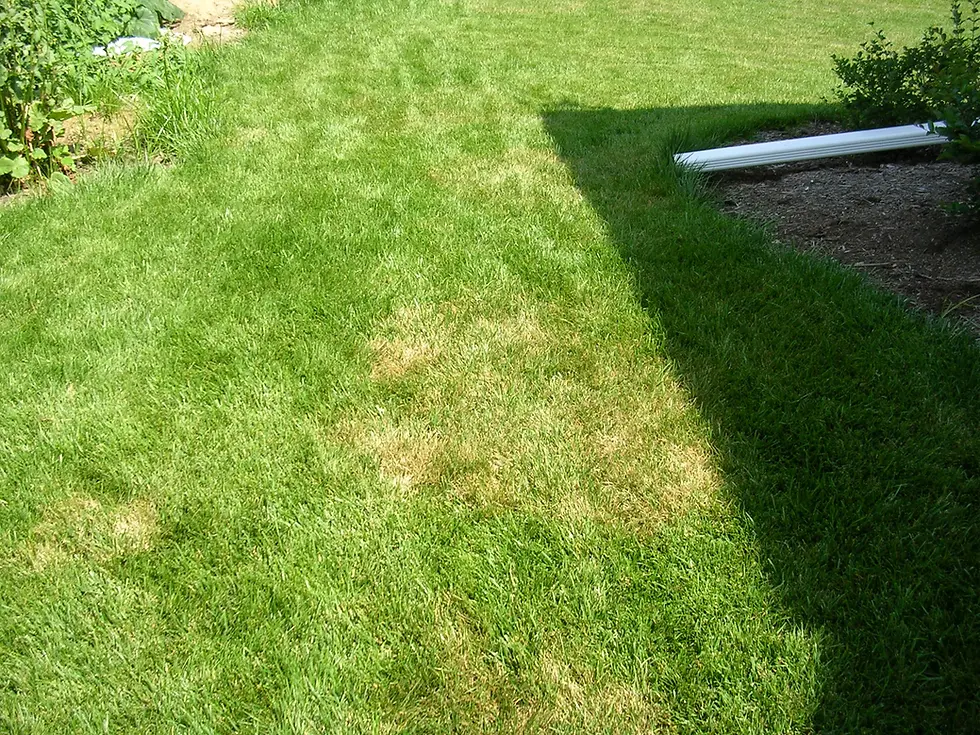
This is particularly important with mixed zones containing 90, 180, and 360 degree rotors. When the full circle areas are under supplied, they may become the first places to show heat stress. The grass turns brown, and the understandable response is to increase the controller.
But every sprinkler in the zone runs longer.
The person managing the lawn is not necessarily being irresponsible. They see brown grass and understandably assume it needs more water. The real problem may be that the irrigation system is asking them to overwater one part of the landscape just to adequately water another.
That is why a brown spot is a symptom, not a diagnosis.
Professional irrigation design accounts for these differences through matched precipitation, proper pressure, appropriate spacing, and nozzle selection. But even a manufacturer's nozzle chart is only a starting point. The landscape still gets the final vote.
If sprinklers are spaced 20 feet apart, the radius has been adjusted, trees have grown, wind affects one side of the property, or pressure has changed, we need to measure what is actually reaching the ground. Catch cups help turn assumptions into evidence.
And even that is only part of the equation.
Water management matters for more than conservation. It matters to the plants themselves because roots need both water and oxygen.
Many of our clay rich and compacted Central Kansas soils drain slowly. When they remain saturated for extended periods, water occupies spaces in the soil that would otherwise contain air. Oxygen movement becomes restricted, and roots can begin struggling even though they are surrounded by moisture.

This year, we have seen a number of newly planted and established trees decline severely or die where prolonged soil saturation appeared to be a significant contributing factor. There were certainly other stresses involved in many of these situations, including compaction, planting problems, restricted root systems, previous drought, and extreme heat. But excessive moisture in the root zone was difficult to ignore.
In several cases, wetter conditions earlier in the summer, including June, were followed by irrigation schedules that continued as though conditions had remained dry.
The weather changed, but the irrigation schedule did not.
Too much water can sometimes be just as damaging as too little. Roots experiencing low oxygen may become less effective at taking up water and nutrients. Plants can even display symptoms resembling drought stress while sitting in wet soil. Leaves wilt. Margins scorch. Growth slows.
Then we see the wilt and add more water. Without realizing it, our solution can become part of the problem.
Trees make this especially important because many of their fine absorbing roots occupy the same upper soil profile we are watering for the lawn. The lawn and tree are not separate systems. They share the soil, the moisture, the oxygen, and the consequences of how we manage all three.
Healthy soil depends on balance. It should not remain excessively dry for extended periods, but it should not remain constantly saturated either. Healthy soil moves through periods of moisture and oxygen that support roots, nutrient cycling, soil biology, and plant growth.
This is where stewardship becomes more important than deciding who is doing something right or wrong.
There is a right way to manage water, but responsible management begins with understanding rather than blame.
Use catch cups to see how much water different areas of the lawn are actually receiving. Watch the sprinklers operate. Check the soil. Pay attention to rainfall. Look for runoff. Evaluate dry areas before increasing the entire system. Adjust irrigation as seasons and landscapes change.
Sometimes fertilizer is appropriate. Sometimes a fungicide is needed. Sometimes a tree requires treatment. And sometimes the landscape simply needs more water.
But before reaching for another product, another application, or another gallon of water, we should first understand what created the problem.
As conversations about our water resources continue, horticulture should not have to stand on the defensive. Healthy lawns, trees, and landscapes provide tremendous value to our communities, but as an industry, we absolutely have a responsibility to manage them wisely.
Maybe the question is not whether we should have beautiful landscapes or conserve water. Maybe good stewardship means learning how to do both.
Because the goal should never be simply using less water, the goal should be using the water we have with greater purpose.


Comments